
Why mapping your WorkChart is the first step in AI governance
Imagine giving an AI agent the job of helping onboard a new customer. Accounts registers the request, Design works out what the customer needs, and Delivery configures the service.
Then the customer asks to go live before a required check is complete. The sales team has promised a date. The delivery team has a procedure to follow. Someone may have authority to approve an exception, and the agent needs to know who that is, what evidence they need, and what work can proceed while the decision is pending.
That moment captures the challenge of AI governance. The organisation needs a framework that sets rules for AI itself. It also needs to connect that framework to the policies, authorities, and decisions that already govern the work.
AI governance has to connect existing frameworks
An AI governance framework should establish who can introduce an agent, what authority can be delegated to it, how its behaviour is monitored, and who can intervene. Those rules apply wherever the organisation uses AI. The decisions an agent encounters depend on the work it has been given.
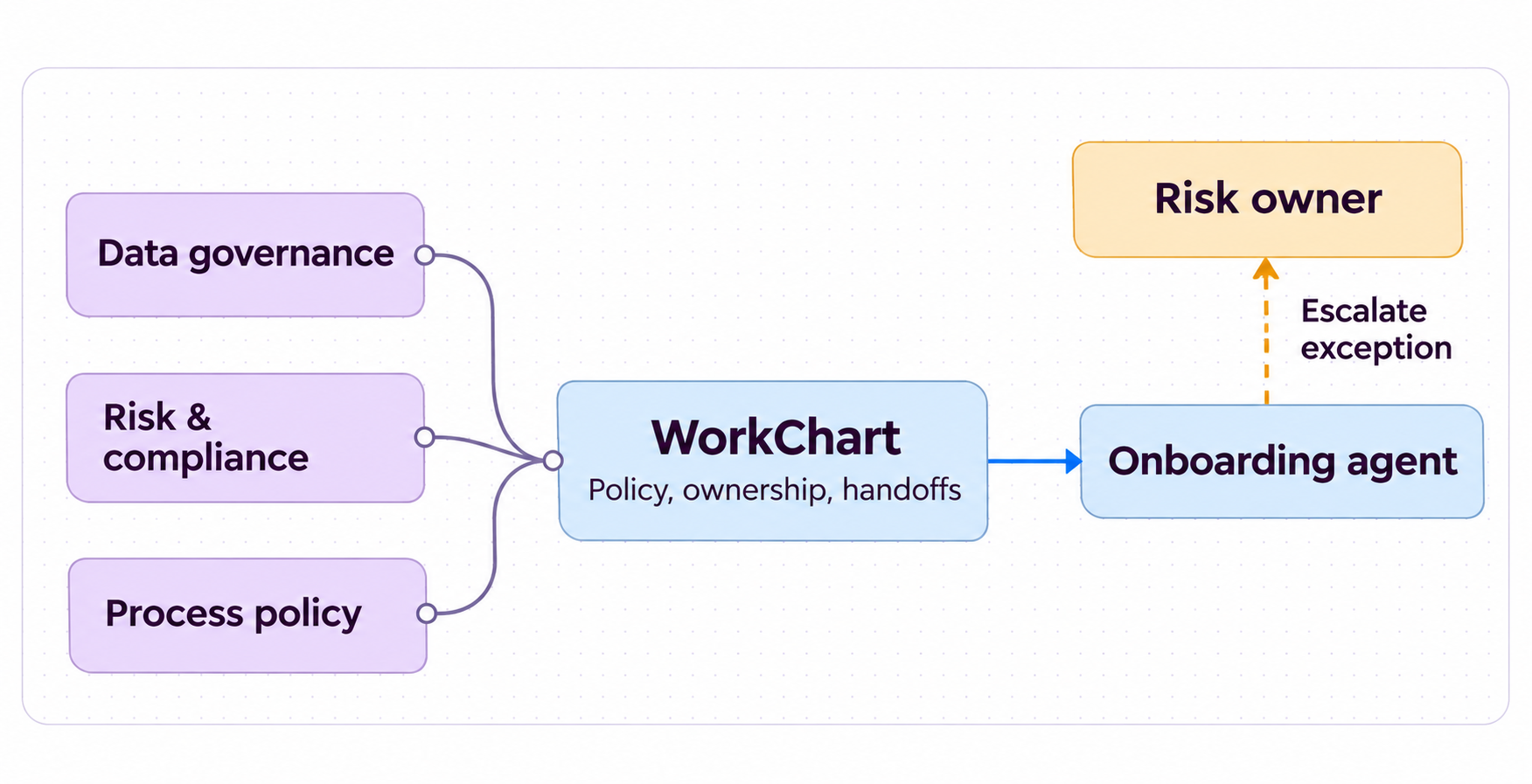
In customer onboarding, data governance defines what customer information the agent can use and share. Risk and compliance determine which checks are mandatory and who can approve an exception. The process owner defines how work moves between teams. Finance and performance management shape commitments around cost, turnaround, and customer outcomes.
Each framework can be sound on its own. The difficulty comes when several apply to one decision. A service target creates pressure to go live, compliance requires a check, and delivery policy may allow preparatory work while approval is pending. The agent needs enough context to act in line with organisational intent and policy, including knowing when a person must decide.
Start by mapping the work
A WorkChart is a shared view of how work gets done. It brings together the customer journey, processes, capabilities, teams, accountable roles, governance forums, financial commitments, and the agents that support the work.
Start with one workflow where an agent will do something consequential. Walk through a real case with the people involved. Follow the work from the customer request to the outcome, paying particular attention to handoffs and exceptions. For each decision, identify the policy that applies, the person accountable, the information the agent can use, and the point at which it must escalate.
The WorkChart also gives the agent a place in the accountability hierarchy. An individual might own a personal assistant. A process owner might be accountable for an agent used across several teams. An executive might be accountable for an agent with a broader operational mandate. The reporting line tells people who can change the agent’s remit, review its behaviour, or suspend its use.
Turn the map into governance people can use
Mapping the onboarding example might reveal that Delivery can prepare the service while a check is pending, that only the risk owner can approve an exception, and that the agent must keep the go-live step on hold until it receives a recorded decision. It might also reveal that the teams disagree about who owns that decision. Resolving that ambiguity is governance work in its own right.
Once the people responsible agree how the work should proceed, they can translate that agreement into permissions, approval steps, tests, and monitoring. The executive team can then see where the agent has authority, which outcomes depend on it, and where human judgement is still required.
That’s why mapping your WorkChart comes first. It gives the organisation a concrete way to decide what it intends an agent to do, which policies apply, and who is accountable when the work crosses functions.